To understand the technical evolution shown in the McKinsey image, you have to look at it as a shift from Human-to-Machine (H2M) manual labor to Machine-to-Machine (M2M) autonomous orchestration.
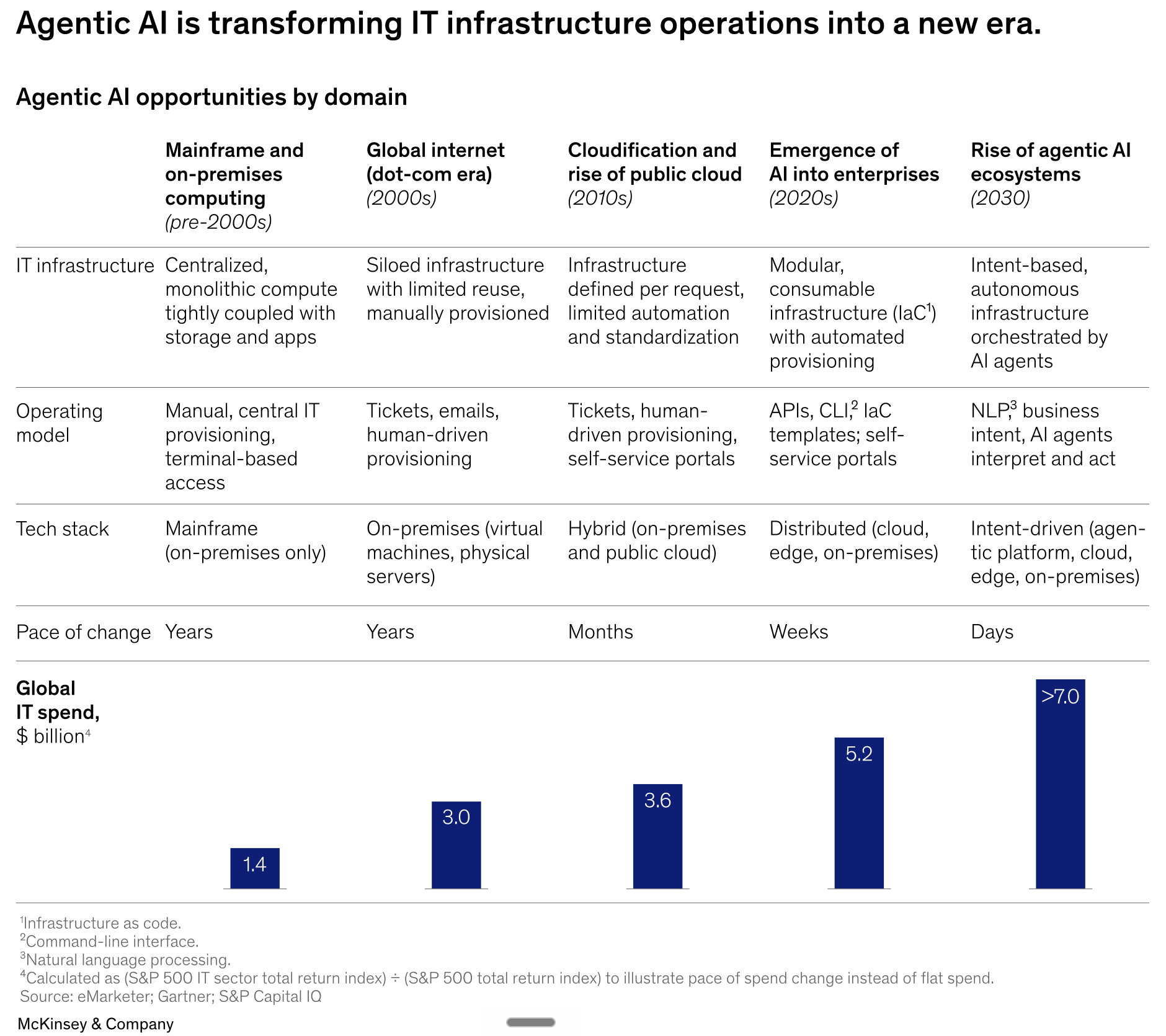
Here is the technical breakdown of the infrastructure stack from 2000 to 2030.
1. The Era of the Command Line (CLI) & Manual Provisioning (~2000)
In the first column of your image, the “Technical Interface” is the CLI (Command Line Interface).
-
What it is: A text-based interface where a human sysadmin types specific commands (e.g.,
mkdir,apt-get install,ifconfig) to interact with the operating system. -
The “Behind the Scenes” Tech: This was the era of Bare Metal. If you needed a server, you physically racked a machine, installed Linux/Windows, and configured it one line at a time.
-
The Problem: It was slow and prone to human error (“fat-fingering” a command could delete a whole database). There was zero “agentic” behavior; the computer did exactly what you typed and nothing more.
2. The Era of Infrastructure-as-Code (IaC) & NLP (2010s–2020s)
The middle column represents where most “Deep Tech” startups currently play.
-
IaC (Infrastructure as Code): Instead of typing commands one by one, we started writing Configuration Files (using tools like Terraform, Ansible, or Kubernetes YAML).
- Technical Logic: You define the “Desired State” (e.g., “I want 5 web servers with 8GB RAM”) and the software makes it happen.
-
NLP (Natural Language Processing): This is the “Chatbot” phase. Using Large Language Models (LLMs), engineers can now say, “Write me a Terraform script for a secure AWS VPC.”
-
The Shift: We moved from Manual to Programmatic. However, a human is still “the boss,” checking the code before it runs.
3. The 2030 Vision: Intent-Based Autonomous Infrastructure
The third column is the Agentic AI Stack. This is the leap from “AI as a tool” to “AI as an operator.”
Key Technical Components:
-
Intent-Based Systems: Instead of writing code (IaC), you provide an Intent.
-
Example: “Ensure the app remains fast for users in Tokyo while keeping costs under $5k/month.”
-
The AI doesn’t just generate code; it reasons about the trade-offs between latency and cost.
-
-
Closed-Loop Automation: The system doesn’t just “set it and forget it.” It monitors the infrastructure 24/7. If a server fails, the agent detects the “drift” from your intent and fixes it autonomously without a human opening a ticket.
-
Self-Healing Code: Deep tech startups are now building agents that can read their own error logs, write a patch, test it in a sandbox, and deploy it—all in seconds.
Deep Data: Business Models & The “ArXiv” Shift
You asked for deeper data on the business models emerging from this (often discussed in recent ArXiv research papers like Revenue-Sharing as Infrastructure, 2026).
| Feature | Legacy Business Model (SaaS) | Agentic Business Model (Deep Tech) |
|---|---|---|
| Pricing Unit | Per User / Per Seat | Per Outcome / Per Task |
| Value Moat | Feature Set | Proprietary Data & Reasoning Accuracy |
| Customer Goal | Ease of Use | Hands-off Execution |
| Infrastructure | Centralized Cloud | Distributed Agentic Orchestration |
Why “Deep Tech” is different here:
A general AI (like ChatGPT) cannot manage a nuclear power plant’s IT or a bank’s high-frequency trading servers. Deep Tech startups win by building the Vertical Agency Layer. They take a general model and wrap it in:
-
Deterministic Guardrails: Ensuring the AI never performs an illegal action.
-
Domain-Specific Knowledge: Training the agent on thousands of hours of specialized infrastructure logs that OpenAI doesn’t have access to.